

A first appointment is not an automatic decision to have surgery. You will need the right scans, medical records and questions so the neurosurgeon can connect your symptoms, examination findings and brain imaging before recommending surgery, observation or another treatment.
Key takeaways
- Bring scan files, reports, medication lists and your complete medical history.
- Seek urgent medical care for sudden weakness, seizures, confusion or a severe new headache.
- A consultation can compare observation, medicines, biopsy, radiation and surgery.
- Ask how the surgeon reached the recommendation and when to seek a second opinion.
Before the appointment: what to bring and when not to wait
Prepare for a routine brain surgery consultation by collecting your complete medical record and the actual scan files, not just a referral letter. A consultation is an assessment, not consent to an operation; the neurosurgeon will match your symptoms, examination and imaging before discussing observation, medicines, biopsy, radiation or surgery.
1. Bring MRI or CT images on a disc, USB drive or image-sharing portal, along with every radiology report. Images show relationships to blood vessels, ventricles and functional brain regions; missing sequences or outdated scans can limit the opinion.
2. Pack discharge summaries, previous operative notes, pathology reports and relevant blood-test results. If tissue testing or molecular analysis is needed, ask how the result could change treatment.
3. Write a symptom timeline: the first symptom, changes in severity, seizures, headaches, vomiting, weakness, numbness, speech or vision changes, and treatments tried. Bring a medication list with exact doses and an allergy list.
4. Do not wait for a private appointment after a new seizure, sudden weakness or numbness, sudden speech or vision disturbance, loss of consciousness, reduced alertness, or a rapidly worsening headache with vomiting. Seek emergency medical assessment immediately, because these symptoms can signal bleeding, stroke, swelling or another time-sensitive problem.
Take your medication list and scan details if this does not delay emergency care.
What happens during the first consultation
The first visit is a diagnostic assessment, not an automatic agreement to brain surgery. The neurosurgeon will connect your symptoms, examination findings and scan appearances before suggesting what the problem could be.
- You will be asked when symptoms began, how quickly they changed and whether they are constant or episodic. Expect questions about headaches, seizures, weakness, numbness, balance, speech, vision, memory, personality changes, previous cancer, injuries, infections and earlier treatment.
- The neurological examination checks alertness, speech, memory, eye movements, facial strength, hearing, limb power, sensation, coordination, reflexes and walking. The findings help show whether a scan abnormality matches a real functional problem.
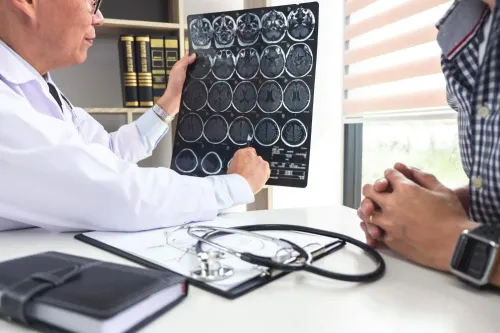
- The surgeon will review the actual MRI or CT images, preferably the DICOM study on a disc, USB drive or image-sharing portal, rather than relying only on the radiology report. Missing sequences or an outdated scan can prevent assessment of blood vessels, ventricles and functional brain regions.
- Bring discharge summaries, operative notes, pathology reports, blood-test results, and a medication list with doses and allergies. For a suspected tumour, ask whether biopsy or resection is needed; tissue and molecular testing can change the diagnosis and treatment.
Only after this review will the surgeon discuss possible diagnoses and options such as monitoring, medication, radiation, endovascular treatment, biopsy or resection. You should leave knowing which information remains uncertain and what test or follow-up resolves it.
How the surgeon decides whether brain surgery is appropriate
A neurosurgeon calls surgery urgent when bleeding, swelling, hydrocephalus, tumour growth or worsening neurological function threatens life or permanent function. Surgery is optional when the condition is stable and observation, medication, radiation or another procedure offers a reasonable alternative.
It is unnecessary when symptoms do not match a surgically treatable problem, imaging shows no dangerous compression, or the expected benefit is too small. It is unsuitable when the lesion’s location, the person’s medical condition or the expected risk of permanent disability makes surgery more harmful than helpful.
The decision combines your symptoms, neurological examination, actual MRI or CT images and relevant test results—not the scan report alone.
Before consenting, ask:
- What exact problem are you treating, and what happens if I wait, observe or choose another treatment?
- Is the goal diagnosis, symptom relief, longer survival, prevention of deterioration or complete removal? For a suspected glioma, ask whether biopsy or resection is needed and how tissue and molecular results would change treatment.
- What are my personal chances of bleeding, infection, seizures, stroke, swelling, cerebrospinal-fluid leakage or a new neurological deficit, and what recovery would involve?
- Who will perform the operation, which hospital and intensive-care services support it, and what follow-up is included?
Seek another opinion when the diagnosis is uncertain, surgery is elective, permanent deficit is a serious risk or specialists disagree. Give the second surgeon the original DICOM images and pathology, not only written summaries.
How to judge a surgeon and use a second opinion
Seek another opinion when the diagnosis is uncertain, surgery is elective, the proposed operation carries a serious risk of permanent disability, or specialists recommend different treatments. Ask the second surgeon to review the original MRI or CT images and pathology slides or reports, not just the referral letter.
The phrase best neurosurgeon brain for surgery consultation describes a search, not a recognised clinical category. Compare the surgeon’s experience with your suspected condition, its anatomical location and the relevant subspecialty, such as cerebrovascular, skull-base, neuro-oncology, epilepsy or functional neurosurgery.
| Compare | Surgeon 1 | Surgeon 2 |
|---|---|---|
| Relevant expertise | Condition, location and operation experience | Condition, location and operation experience |
| Recommendation | Surgery, observation, biopsy or another treatment | Surgery, observation, biopsy or another treatment |
| Expected outcome | Chance of control, function and independence | Chance of control, function and independence |
| Risks and recovery | Permanent deficits, hospital stay and rehabilitation | Permanent deficits, hospital stay and rehabilitation |
| Team support | Neuro-oncology, neuroradiology and rehabilitation access | Neuro-oncology, neuroradiology and rehabilitation access |
Board certification and specialist training are useful checks, but neither proves a surgeon is “best” for every operation. For a tumour, ask whether a multidisciplinary team will review the case and whether tissue or molecular testing could change treatment. A best neurosurgeon consultation should leave you with comparable numbers, alternatives and reasons—not a slogan.
Choosing a practical consultation in Worli or elsewhere
A search for neurosurgeon consultation worli is only a starting point; choose the surgeon and hospital, not the neighbourhood. Verify the doctor’s professional registration and ask which hospital would handle surgery, intensive care, neuroanaesthesia, neuroradiology, pathology and rehabilitation.
If you book with Dr. Anshu Warade, confirm these arrangements directly rather than assuming the clinic provides every service.
| Route | Check before booking | Practical trade-off |
|---|---|---|
| Clinic appointment | Consultation fee, available dates, expected waiting time and referral requirements | Convenient for discussion, but surgery and admission occur elsewhere |
| Hospital outpatient visit | Hospital name, emergency access, imaging review and billing process | Easier coordination, but travel and queues may be longer |
| Teleconsultation | Whether original DICOM images can be shared and whether an examination is still needed | Saves travel, but cannot replace an urgent neurological assessment |
Ask for the total consultation fee, follow-up fee, cancellation rule and payment method. Check parking or public transport, travel time after a procedure, and whether a family member can attend. Before leaving, obtain the follow-up date, contact for post-discharge problems, and the waiting period for scan review or pathology results.
If symptoms worsen while waiting, use emergency care instead of holding the appointment.
Related service
Neurological Examination 🧠 Neurological Examination by Dr. Anshu Warade A Neurological Examination is a detailed clinical assessment used to evaluate the functioning of the... View service → |
How to leave with a clear plan
After the first opinion, leave with a written decision rather than a surgery date alone. It should state the working diagnosis, urgency, alternatives, recommended tests, expected benefit, major risks, follow-up date and who to contact. For a suspected tumour, ask whether biopsy or resection is needed and how pathology and molecular testing would change treatment.
A child’s visit needs a paediatric-focused assessment, including development, school function, seizures, weight, medicines, anaesthetic history and the child’s own questions. Ask whether a paediatric neurosurgeon, paediatric anaesthetist and age-appropriate rehabilitation services will be involved.
- Seek a second opinion when the diagnosis is uncertain, surgery is elective, permanent disability is a serious risk, or specialists disagree.
- Confirm that the second surgeon reviewed the original MRI or CT images and pathology, not only the reports.
- Do not stop anticoagulants or seizure medicines without a coordinated medical plan.
- Treat pressure to consent immediately, guaranteed outcomes, ignored alternatives or no follow-up plan as red flags.
| Situation | Clear plan should include | Warning sign |
|---|---|---|
| First opinion | Diagnosis, options and next step | Immediate commitment demanded |
| Second opinion | Image and pathology review | Written summary alone reviewed |
| Child’s visit | Development and family questions | Adult-only explanation |
Frequently asked questions
What should I bring to a brain surgery consultation?
Bring your complete medical record, scan reports, actual CT or MRI files, medication list, previous operation notes and a written symptom timeline.
What happens during a first neurosurgeon consultation?
The surgeon reviews your symptoms and medical history, examines you, studies your imaging and explains possible diagnoses, treatment choices and next steps.
How does a neurosurgeon decide whether brain surgery is appropriate?
The decision combines your symptoms, neurological examination, diagnosis, scan findings, risks, expected benefit and alternatives such as observation, medicines, biopsy or radiation.
When should you seek a second opinion for brain surgery?
Request a second opinion when the diagnosis is unclear, surgery is being recommended, the risks are substantial or you want to compare treatment approaches.
How can you judge a neurosurgeon during a consultation?
Ask about experience with your specific condition, the proposed procedure, alternatives, complication risks, recovery and what evidence supports the recommendation.