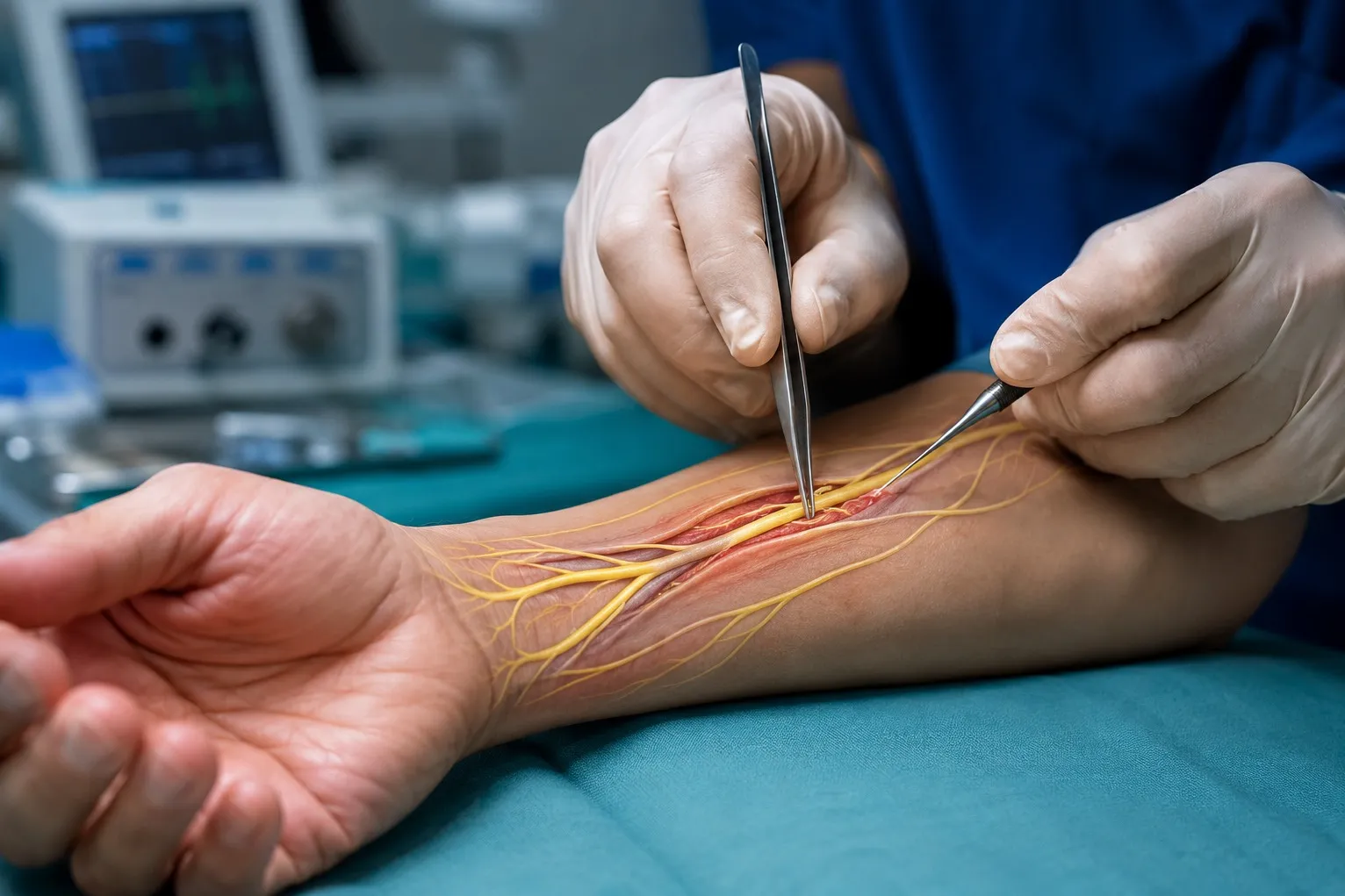
A nerve injury can occur after an accident, deep cut, fracture, dislocation, surgical injury, or prolonged compression. Unlike a simple skin wound, nerve damage can affect sensation and muscle control long after the original injury appears to have healed. Choosing the right Treatment of Nerve Injuries therefore depends on understanding what happened to the nerve itself.
Patients in Dadar with persistent numbness or weakness after an injury may require specialised evaluation.
Not Every Nerve Injury Is the Same
Peripheral nerves can be affected at different levels of severity.
A mild injury may temporarily disrupt nerve signals while leaving the basic nerve structure intact. More significant injuries can damage internal nerve fibres, and severe trauma can partially or completely divide a nerve.
This difference has a major influence on treatment and recovery.
Symptoms That Deserve Evaluation
Following an injury, patients should pay attention to persistent:
- Numbness
- Tingling
- Burning or electric sensations
- Muscle weakness
- Difficulty moving fingers or limbs
- Loss of grip
- Reduced sensation
- Muscle wasting
Symptoms that do not improve or that become progressively worse should be investigated.
How Is a Nerve Injury Assessed?
The evaluation begins with understanding how and when the injury occurred.
The doctor may test muscle strength, reflexes, sensation, and the distribution of symptoms. Nerve conduction studies or electromyography can provide additional information about nerve function.
Imaging may also be useful in selected cases.
Dr. Anshu Warade uses these findings to determine the appropriate Treatment of Nerve Injuries and whether observation, rehabilitation, or surgical intervention should be considered.
When Might Surgery Be Needed?
Some nerves recover gradually without an operation, particularly when their structural continuity is preserved.
Surgical evaluation may become more important when:
- A nerve has been completely divided.
- Significant weakness persists.
- There is evidence of severe compression.
- Recovery does not progress as expected.
- Scar tissue interferes with nerve function.
- The injury involves structural damage requiring repair.
Possible surgical approaches vary according to the type and location of injury.
Why Timing Can Matter
Nerves recover slowly, and meaningful improvement may take time. However, waiting indefinitely when there is severe structural damage can also affect treatment planning.
Muscles that lose nerve supply for prolonged periods can undergo changes that influence functional recovery.
This makes regular reassessment important rather than relying only on whether pain has reduced.
For people in Dadar and across Mumbai, Maharashtra, treatment planning should consider both the original injury and current nerve function.
Recovery after nerve injury varies considerably. The severity of damage, location, time since injury, age, and associated injuries can all influence progress. A detailed assessment with Dr. Anshu Warade can clarify the extent of nerve involvement and whether continued observation, rehabilitation, decompression, repair, or another surgical strategy is appropriate.
Keywords