A cut, crush injury, injection, fracture or dislocation does not automatically mean you need an operation. The decision depends on whether the nerve is bruised, compressed, scarred, stretched or completely divided, along with changes in movement, sensation and muscle function over time.
Key takeaways
- Treat new paralysis, heavy bleeding and poor limb circulation as emergencies.
- Open nerve cuts and trapped nerves need prompt specialist assessment.
- EMG, nerve-conduction studies and serial examinations track recovery.
- Choose a specialist who explains timing, tests, alternatives and expected recovery.
Which nerve injuries need urgent assessment after an accident?
An open wound with lost movement or sensation needs emergency care, not a routine appointment. Go to an emergency department for new paralysis, rapidly worsening weakness, severe uncontrolled or electric pain, heavy bleeding, a retained foreign body, expanding swelling, or a limb that becomes cold, pale or poorly perfused.
| Finding | Required response |
|---|---|
| Open cut plus named-nerve weakness or numbness | Emergency assessment today; do not wait for pain to settle |
| Cold, pale limb, heavy bleeding or expanding swelling | Immediate emergency care for circulation and bleeding control |
| Penetrating wound, foreign body or new paralysis | Emergency assessment and urgent specialist referral |
After a glass or machinery cut, penetrating trauma, injection injury, crush injury, fracture or dislocation, arrange assessment immediately or the same day.
The answer to which nerve injuries need surgery in Mumbai starts with the injury pattern, not the city: a cut nerve, vascular injury, tendon damage, severe contamination or trapped foreign body needs prompt specialist review.
Initial care includes controlling bleeding, checking pulses and circulation, cleaning and covering the wound, and assessing bone, tendon and blood-vessel damage. Closing the skin does not restore a divided nerve.
Early referral still matters when surgery must wait for stabilisation or wound treatment. Prolonged denervation reduces the ability of muscle motor end plates to respond to reinnervation, lowering the chance of useful recovery. A fresh open injury with dysfunction in a named nerve should not wait for an outpatient consultation.
How does the type of nerve damage change the treatment plan?
The damaged structure determines when nerve injury requires surgery: a temporary block is watched, while a divided nerve needs reconstruction.
| Type | Practical meaning | Usual treatment direction |
|---|---|---|
| Neurapraxia | Temporary conduction block; the nerve remains continuous | Protection, pain control, physiotherapy and observation while function returns |
| Axonotmesis | Axons are damaged but supporting nerve structure remains; regrowth takes time | Serial examinations and rehabilitation; investigate if recovery stalls |
| Neurotmesis | The nerve is completely disrupted and useful continuity usually cannot return without repair | Early specialist assessment, repair or reconstruction |
Many closed stretch or crush injuries begin without immediate surgery because the nerve may recover spontaneously. Protect the limb, control pain, maintain joint movement through physiotherapy and record muscle power, sensation and reflexes at repeated examinations.
The operative pathway depends on what is blocking recovery:
- Decompression releases a nerve trapped by a fracture, mass or tight surrounding tissue.
- Neurolysis frees a nerve tethered by scar tissue.
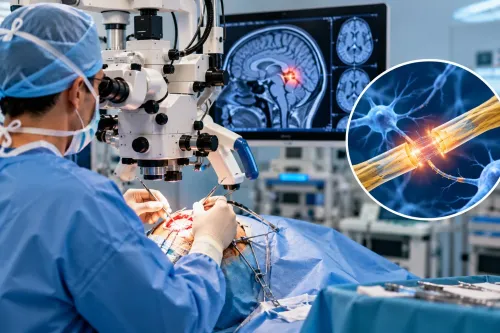
- Direct microsurgical repair joins divided ends that meet without tension.
- A nerve graft bridges a gap that prevents direct joining.
- A nerve transfer supplies a working donor nerve when the original nerve cannot be repaired effectively.
- A muscle-tendon transfer restores movement when useful nerve recovery is no longer realistic.
Observation changes to further investigation and possible exploration when function fails to improve, a sensory deficit enlarges or weakness progresses. Electromyography, nerve-conduction testing and imaging help locate the lesion, but the examination and the time since injury determine whether waiting risks permanent muscle denervation.
Which examination and tests show whether a nerve is recovering?
Pain does not prove that a nerve has stopped working. A specialist records motor strength, the exact sensory territory, reflexes, muscle wasting and the pattern of weakness, then checks whether Tinel’s sign moves or advances along the nerve as it regenerates.
Loss that follows a named nerve carries more weight than pain alone because it maps a specific anatomical injury.
| Test | What it shows | Important limit |
|---|---|---|
| Clinical examination | Objective motor, sensory and reflex change | Serial examinations are often needed |
| Nerve-conduction study | Slowed, blocked or absent signal; injury location and severity | A very early normal result can miss major damage |
| Electromyography | Denervation and affected muscles; injury level and grade | Denervation changes often take 2–3 weeks to appear |
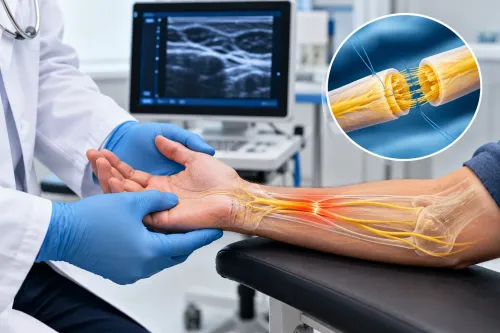
| Ultrasound | Discontinuity, swelling, neuroma or focal compression | Less useful for deep or complex injuries |
| Magnetic-resonance neurography | A deeper lesion or brachial-plexus injury | It supplements, rather than replaces, examination |
Nerve-conduction studies and electromyography performed too soon can be falsely reassuring, so repeat testing may be needed. Ultrasound is valuable for a superficial injured nerve; magnetic-resonance neurography helps when the lesion lies deep or involves the brachial plexus. Imaging and electrodiagnostic tests support the examination, but they do not decide exploration by themselves.
Lack of recovery, an enlarging sensory deficit or progressive weakness can shift observation toward further investigation and surgery.
Which structural problems are strongest indications for nerve surgery?
A completely divided nerve, visible nerve damage in an open laceration, or a nerve compressed by scar, a mass or fracture are the strongest nerve injury surgery indications in Mumbai.
| Problem | Why surgery is considered | Possible treatment |
|---|---|---|
| Completely divided nerve | Useful continuity cannot return on its own | Direct repair or grafting |
| Open laceration with visible nerve damage | Skin closure does not reconnect the nerve | Microsurgical repair, grafting or transfer |
| Nerve trapped in scar tissue | Tethering blocks nerve movement and recovery | Neurolysis or decompression |
| Compression by a mass or fracture | Ongoing pressure can worsen weakness and sensation | Decompression and treatment of the cause |
| Closed injury with persistent or worsening paralysis | No clinical recovery suggests major disruption | Exploration, grafting or nerve transfer |
Urgency increases with tendon or vascular damage, severe contamination, a foreign body or an expanding haematoma. A fresh wound with lost movement or sensation in a named-nerve distribution needs specialist assessment even after the skin has been closed.
Severe burning or electric pain alone does not prove that surgery is needed. A correctable painful neuroma, entrapment or discontinuity supports surgery when medication, therapy and other non-operative treatment have failed.
Brachial-plexus injuries require a different assessment from a single cut nerve. Weakness patterns, sensory loss, Horner syndrome, fractures, root-avulsion findings, electrodiagnostic studies and imaging may support grafting or nerve transfer; selected late cases may require tendon or muscle transfer.
How should you choose a nerve repair specialist in Mumbai?
Mumbai has no separate operating threshold for nerve injuries. A nerve repair specialist in Mumbai should base the referral on the injury type, examination, test results, time since injury and realistic functional benefit—not the facility’s advertising.
| Specialist background | Useful expertise | What to confirm |
|---|---|---|
| Neurosurgery | Complex nerve, root or plexus assessment | Experience with peripheral-nerve reconstruction |
| Plastic and reconstructive surgery | Microsurgical repair, grafting and soft-tissue reconstruction | Access to coordinated rehabilitation |
| Orthopaedic hand surgery | Hand, wrist and upper-limb nerve injuries | Ability to assess tendons, bones and vessels |
| Peripheral-nerve surgery | Decompression, neurolysis, repair and transfers | Clear outcome planning and follow-up |
Choose a team with coordinated microsurgical peripheral-nerve expertise and rehabilitation. A hospital that simply advertises “nerve surgery” may not provide the examination, reconstruction options or therapy required after the operation.
For a consultation with Dr. Anshu Warade, bring:
- The injury date and mechanism
- Wound photographs or a detailed wound description
- Operative notes and examination reports
- EMG and nerve-conduction results
- Ultrasound, MRI, X-ray or other imaging
The specialist should compare observation and rehabilitation with repair, grafting, decompression, neurolysis or nerve transfer. Ask what waiting could cost, what function surgery can realistically restore and which limits may remain even after treatment. That explanation matters more than a hospital’s promotional label.
Related service
Neurological Examination 🧠 Neurological Examination by Dr. Anshu Warade A Neurological Examination is a detailed clinical assessment used to evaluate the functioning of the... View service → |
Frequently asked questions
Which nerve injuries need urgent assessment after an accident?
Seek emergency care for new paralysis, rapidly worsening weakness, severe uncontrolled or electric pain, heavy bleeding, a retained foreign body, expanding swelling, or a cold, pale or poorly perfused limb.
How does the type of nerve damage change the treatment plan?
A bruised or stretched nerve may recover with protection, rehabilitation and monitoring. A cut, severe crush, trapped nerve or persistent compression requires assessment for repair, grafting or decompression.
Which tests show whether a nerve is recovering?
Serial strength and sensation examinations, electromyography and nerve-conduction studies help track recovery. Ultrasound or MRI can show nerve continuity, swelling, compression or surrounding structural damage.
Which structural problems are strongest indications for nerve surgery?
A completely divided nerve, an open injury with loss of function, a nerve trapped in scar or bone, persistent compression with deterioration, or a painful neuroma warrants prompt surgical evaluation.
How should you choose a nerve repair specialist in Mumbai?
Ask about experience with peripheral-nerve and brachial-plexus injuries, the proposed test sequence, timing, repair options, rehabilitation plan, expected recovery and risks. Request clear follow-up arrangements.
Keywords