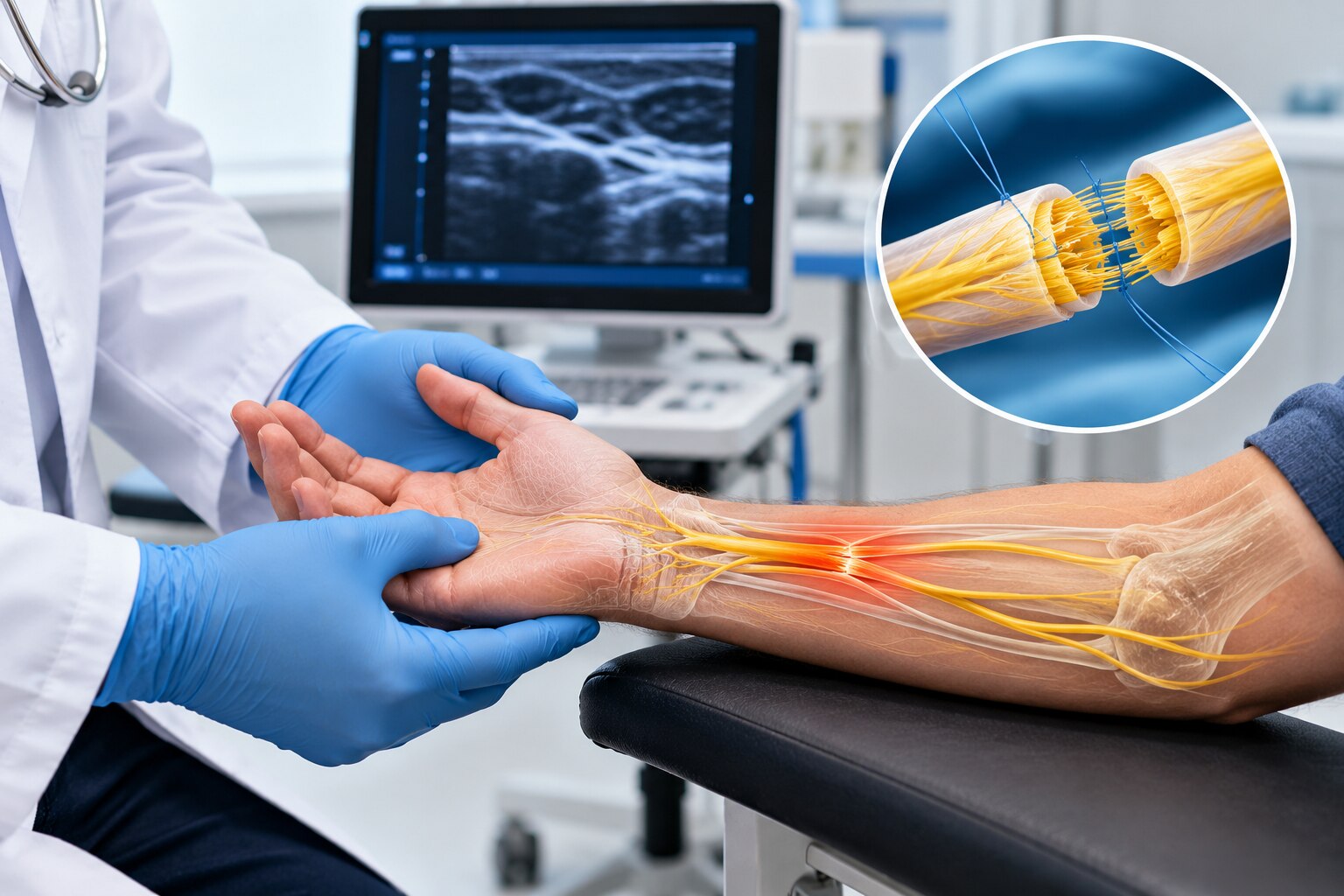
A cut, crush, stretch, tumour or trapped nerve does not automatically require the same operation. By separating the injured structure from the cause of damage, you can understand when repair, grafting, decompression, nerve transfer or rehabilitation is the appropriate path—and when brain surgery is the wrong description.
Key takeaways
- A complete nerve rupture, visible gap, or worsening weakness needs prompt specialist assessment.
- EMG, nerve-conduction studies, MRI, ultrasound, and examination help locate the damage.
- Nerve repair, grafting, transfer, decompression, and neuroma surgery treat different injuries.
- Choose a team that matches peripheral-nerve, spine, or brain involvement to your diagnosis.
Which nerve injuries can surgery actually address?
Surgery addresses a nerve when its structure or function has a correctable problem: an open or complete laceration, partial tear, scar entrapment, narrowing in a tunnel, severe traction injury, painful neuroma, or compression causing progressive weakness or sensory loss. A complete rupture, visible gap, worsening deficit, or failed recovery makes reconstruction more likely than observation.
| Injury pattern | What it means | Likely approach |
|---|---|---|
| Neurapraxia | The nerve remains continuous but has a temporary conduction block | Observation, splinting and rehabilitation while recovery is monitored |
| Axonotmesis | Axons are damaged although the outer nerve framework remains | Serial examinations; surgery if recovery stalls or the nerve is trapped |
| Neurotmesis | The nerve is completely disrupted | Direct repair, grafting or nerve transfer |
| Entrapment or neuroma | Scar, a narrow tunnel or an abnormal nerve end causes dysfunction or pain | Neurolysis, decompression, neuroma excision or reconstruction |
The main nerve injury surgery applications are external neurolysis, decompression, direct end-to-end repair, nerve grafting and nerve transfer. Direct repair works when the ends meet without tension; a graft bridges a gap, while a transfer connects a working donor nerve to the damaged target.
If useful movement cannot be restored through the nerve, tendon or muscle transfer can provide salvage.
Surgery cannot restore every damaged nerve. A bruised or stretched nerve that remains in continuity and is steadily recovering often needs observation, not exploration. Long-standing axonal loss, severe muscle wasting or irreversible spinal-cord damage limits the result, so early specialist assessment matters.
Does the injured structure require brain surgery, spine surgery or peripheral-nerve surgery?
The injured structure determines the specialist and operation: an arm or leg nerve usually needs peripheral-nerve reconstruction, not brain surgery. Repair, grafting, nerve transfer or neurolysis addresses the damaged nerve itself.
A nerve root may need spinal decompression when a disc, fracture, bone fragment, tumour, scar or narrowed canal is pressing on it. Decompression can remove ongoing pressure, but it cannot reliably restore axons lost through long-standing damage. A spinal-cord injury requires a different assessment and cannot be treated by sewing a peripheral nerve back together.
Brachial-plexus traction injuries can cause a rupture or root avulsion. A graft or nerve transfer can help selected injuries, but an avulsed root usually cannot be sewn back to the spinal cord.
The phrase brain surgery for nerve damage is imprecise. Skull-base or cranial surgery has a role when a tumour, vascular lesion, hydrocephalus or bone abnormality affects a cranial nerve. Selected cases involving the facial, trigeminal, optic, vestibulocochlear or lower cranial nerves may require that approach; microvascular decompression can treat specific trigeminal neuralgia or hemifacial-spasm cases.
The question what nerve injuries can brain for surgery address in mumbai should therefore be narrowed to the structure involved:
- Limb nerve: peripheral-nerve or reconstructive surgery.
- Nerve root: spinal assessment and decompression when a correctable cause exists.
- Cranial nerve: skull-base or cranial-nerve assessment.
- Spinal cord: specialist neurological and spinal-cord evaluation, not peripheral-nerve repair.
How do doctors decide whether a nerve is intact and surgery is time-sensitive?
Doctors combine the examination, repeat testing and imaging before recommending exploration or reconstruction. They map sensation, grade each affected muscle, test reflexes, and compare both limbs for weakness, wasting and pain. A clear cut, suspected rupture or severe traction injury warrants prompt specialist assessment because denervated muscle gradually loses its ability to respond to reinnervation.
| Evidence | What it shows | Effect on timing |
|---|---|---|
| Clinical examination | Motor loss, sensory territory, reflex change, wasting and pain | Progressive loss raises concern for surgery |
| Nerve-conduction study and electromyography | Lesion location, conduction block, axonal loss and reinnervation | An early normal or limited study does not exclude serious injury; denervation changes can take days to weeks |
| High-resolution ultrasound | Discontinuity, swelling, entrapment, neuroma or graft condition | A structural gap or trapped nerve supports exploration |
| MRI or MR neurography | Nerve, roots, plexus, scar and a possible mass | Adds anatomical detail when the injury site is unclear |
A nerve that remains in continuity with returning strength or sensation can be observed with splinting, physiotherapy, pain treatment and serial examinations. No meaningful improvement on follow-up shifts the balance toward surgery.
An open laceration, visible gap, entrapment or worsening deficit makes delay more concerning than a bruised or stretched nerve that is recovering. Doctors therefore judge timing from the injury pattern and evidence of recovery, not one test or a universal deadline.
Which operation matches the nerve damage, and what recovery can it deliver?
Direct end-to-end repair is preferred when the nerve ends meet without tension. If a gap prevents that, surgeons choose a bridge or a new nerve connection based on the injury’s length, location, severity and timing.
| Option | What it does | When it applies |
|---|---|---|
| Direct repair | Joins the nerve ends | Clean cut with tension-free contact |
| Autologous nerve graft | Bridges a gap using your own donor nerve | The ends cannot meet safely |
| Processed allograft or conduit | Provides a bridge without the usual donor-nerve harvest | Selected gaps and nerve injuries |
| Nerve transfer | Connects a functioning donor nerve to the damaged target | The original nerve will not recover soon enough |
| Neurolysis | Frees an intact nerve from constricting scar | Entrapment or scar-related restriction |
| Neuroma excision with reconstruction or targeted muscle reinnervation | Removes a painful abnormal nerve end and gives axons a new target | Persistent focal neuroma pain |
| Tendon or muscle transfer | Restores movement without waiting for nerve regrowth | Useful reinnervation is no longer realistic |
A decompression can release pressure, but it cannot reliably reverse long-standing axonal loss. Removing a neuroma alone is not always enough; reconstruction or targeted muscle reinnervation may be needed to control pain and prevent recurrence.
Recovery develops over months, not immediately. After an initial delay, axons regenerate at roughly 1 millimetre per day, so distance to the muscle matters. Injury severity, age, muscle condition and rehabilitation influence the result, and complex reconstruction cannot promise complete function.
How should you choose a Mumbai team for a complex nerve injury?
Choose the team by the injured structure, not by the word “neurosurgeon” alone. Ask whether the clinician regularly operates on peripheral nerves, nerve roots, brachial plexus injuries, spinal cord conditions or cranial nerves.
| Structure | Question to ask | Why it matters |
|---|---|---|
| Peripheral nerve | How often do you repair, graft or decompress this nerve? | Limb nerves require reconstruction suited to the injury level. |
| Root or spinal cord | Is the problem compression, root avulsion or cord damage? | A spinal operation differs from peripheral-nerve repair. |
| Brachial plexus | Do you treat ruptures and root avulsions with grafts or transfers? | An avulsed root cannot usually be sewn back to the spinal cord. |
| Cranial nerve | Is skull-base, vascular or tumour-related surgery relevant? | Cranial-nerve treatment is not a substitute for repairing an arm or leg nerve. |
Take these to the appointment:
- Injury date, wound description, photographs, prior scans, operation notes, medication list and nerve-conduction or electromyography reports.
- Ask whether ultrasound, MRI or MR neurography is needed to show discontinuity, scar, entrapment, neuroma, root or plexus damage.
- Ask whether the plan is repair, graft, transfer, decompression, neurolysis, neuroma treatment or tendon transfer.
- Ask which recovery signs will be measured, when they will be checked and who will supervise rehabilitation.
A suitable team may include a neurosurgeon, peripheral-nerve or hand surgeon, plastic and reconstructive surgeon, neurologist, radiologist, pain physician and rehabilitation specialist. Dr. Anshu Warade can contribute to assessment of peripheral-nerve, brachial-plexus, spinal-root or cranial-nerve problems.
This is the practical standard for complex nerve injury treatment in mumbai, including nerve injuries treated by neurosurgeon in mumbai.
Related services
Neurological Examination 🧠 Neurological Examination by Dr. Anshu Warade A Neurological Examination is a detailed clinical assessment used to evaluate the functioning of the... View service → |
Brain (Cranial) Surgeries 🧠 Brain (Cranial) Surgeries by Dr. Anshu Warade Brain (Cranial) Surgeries involve advanced surgical procedures to treat conditions affecting the... View service → |
Frequently asked questions
Which nerve injuries can surgery actually address?
Surgery can address lacerated or ruptured nerves, partial tears, scar entrapment, tunnel compression, severe traction injuries, painful neuromas, and progressive weakness from compression.
Does nerve damage require brain, spine, or peripheral-nerve surgery?
The location determines the specialty. Brain surgery addresses central lesions, spine surgery addresses nerve-root or spinal-cord compression, and peripheral-nerve surgery addresses nerves outside the brain and spinal cord.
How do doctors decide whether a nerve is intact and surgery is time-sensitive?
Doctors combine strength and sensation testing with EMG, nerve-conduction studies, ultrasound, MRI, and the injury history. A visible gap, complete rupture, worsening deficit, or absent recovery increases urgency.
Which operations match different types of nerve damage?
Direct repair suits clean ends that can meet without tension. Grafting bridges a gap, nerve transfer redirects a working nerve, decompression releases pressure, and neuroma surgery treats a painful nerve scar.
How should you choose a Mumbai team for a complex nerve injury?
Ask which specialist will lead your case, whether the team treats peripheral nerves, nerve roots, or brain conditions, which tests support the diagnosis, and what recovery milestones and risks they expect.
Keywords