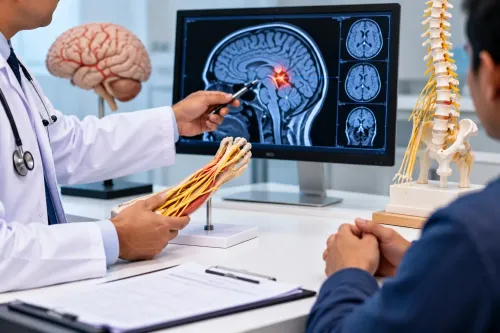
A traumatic brain injury needs surgery when bleeding, swelling, a skull fracture or a penetrating wound threatens brain function, not simply because the scan looks alarming. By the end, you will know which CT findings and neurological changes drive an operation, when observation is safer, and how to choose urgent care in Mumbai.
Key takeaways
- An epidural haematoma over 30 cm³ usually needs urgent evacuation.
- Observation requires serial CT scans and neurosurgical monitoring.
- GCS, focal neurological deficits and midline shift affect the treatment decision.
- Ask which operation, recovery plan and emergency support the hospital provides.
Which CT findings make traumatic brain injury surgery more likely?
An epidural haematoma over 30 cm³ usually requires urgent evacuation. A smaller collection can be observed with serial CT and neurosurgical monitoring when it is under 15 mm thick, shifts the midline by less than 5 mm, and the patient has a GCS above 8 with no focal neurological deficit.
| Pattern | CT or clinical trigger | Usual implication |
|---|---|---|
| Acute subdural haematoma | More than 10 mm thick or more than 5 mm midline shift | Evacuation, regardless of GCS |
| Smaller subdural | GCS falls by 2 points, a pupil is fixed or asymmetric, or intracranial pressure stays uncontrolled | Urgent escalation |
| Contusion or intraparenchymal haematoma | Frontal or temporal lesion over 20 cm³ with at least 5 mm shift or cisternal compression, or any lesion over 50 cm³ | Surgery becomes more likely |
Contusions are not judged by volume alone. Neurological deterioration, worsening mass effect, compressed basal cisterns, midline shift or refractory intracranial hypertension can make surgery necessary below those size thresholds.
Posterior-fossa bleeding needs rapid specialist review because modest volume can compress the brainstem or block cerebrospinal-fluid flow. Hydrocephalus, fourth-ventricle distortion or deterioration strengthens the case for surgery. Traumatic subarachnoid haemorrhage with hydrocephalus, penetrating or open injuries, traumatic cerebrospinal-fluid leaks, and depressed or contaminated skull fractures also require urgent assessment.
Which traumatic brain injuries need surgery in Mumbai depends on the injury pattern, examination, CT and deterioration, not the city. These are the core head injury surgery criteria; loss of consciousness or vomiting alone does not prove that an operation is needed.
How do examination findings change the decision between surgery and observation?
The scan and the patient’s condition matter together. A CT may show a collection, but a Glasgow Coma Scale (GCS) score of 8 or less, a falling score, or new neurological changes can turn observation into an immediate neurosurgical emergency.
Escalate immediately for:
- Worsening confusion, drowsiness or loss of consciousness
- An unequal or newly fixed pupil
- New weakness, abnormal posturing or another focal deficit
- Repeated seizures
- Signs of herniation, such as pupil changes with declining consciousness
Sustained intracranial pressure above 22 mmHg is a treatment warning, not an automatic command to perform a craniotomy. The team weighs the pressure trend against CT mass effect, cerebral perfusion pressure, pupil findings and the response to sedation, ventilation and osmotherapy.
Observation is an active plan when the examination remains stable, bleeding is limited, dangerous mass effect is absent, trained staff can perform reliable neurological checks and repeat CT scans are scheduled. Vomiting or a brief loss of consciousness alone does not prove that surgery is needed.
A normal first CT does not end assessment if consciousness worsens, anticoagulants or antiplatelet medicines are involved, or safe home observation is unavailable. An epidural haematoma or contusion can enlarge after scanning. Children need age-adjusted assessment and specialist paediatric decisions, not automatic adult thresholds. These principles guide tbi surgery indications in mumbai as elsewhere.
What operation is used, and what happens before the patient reaches theatre?
The operation depends on what is causing the danger, not simply on how alarming the scan looks. An emergency craniotomy removes an epidural, subdural or other haematoma and replaces the bone flap; it does not leave the skull open.
1. Decompressive craniectomy removes part of the skull and leaves it off temporarily when brain swelling causes intracranial hypertension despite appropriate medical treatment. A severe-looking CT alone does not automatically justify this operation.
2. Burr-hole drainage creates a small access point for selected liquefied collections, such as a chronic or liquefied subdural collection. It is not the usual treatment for every acute traumatic bleed.
3. Elevation with debridement cleans contaminated tissue and lifts a depressed fracture, particularly when the fracture is open, reaches the inner-table depth, penetrates the dura, causes a haematoma or produces neurological deficit.
4. Acute traumatic bleeding is not usually treated through a skull-base or endoscopic operation. Emergency TBI surgery is a different pathway from elective tumour surgery or other planned cranial procedures.
Before theatre, the team protects the airway, supports breathing and oxygenation, immobilises the neck spine, and manages blood pressure. Clinicians perform a rapid neurological examination, review anticoagulant and antiplatelet medicines, reverse their effects when indicated, treat seizures, and obtain an urgent non-contrast CT. Do not wait for an outpatient appointment or routine MRI referral.
Call an ambulance for worsening drowsiness, repeated vomiting, a seizure, unequal pupils, weakness, blood or clear fluid from the nose or ear, or any penetrating injury. This is the emergency pathway for serious brain injury treatment in Mumbai.
How should you choose emergency TBI care in Mumbai?
Go to the nearest trauma hospital with neurosurgical capability; do not cross Mumbai to reach a named surgeon or wait for a location-specific consultation. Serious brain injury treatment in Mumbai depends on the injury pattern, examination, CT findings, intracranial pressure and deterioration.
A smaller facility can stabilize the airway, breathing and circulation, obtain CT imaging, contact neurosurgery and arrange transfer.
| Facility feature | Why it matters | What to confirm |
|---|---|---|
| 24-hour CT | Shows bleeding, swelling and skull injury quickly | Non-contrast head CT is available now |
| Immediate neurosurgical cover | Speeds decisions about evacuation or transfer | A neurosurgeon can review the scan urgently |
| Neuro-intensive-care beds | Supports ventilation, pressure control and close observation | ICU staff manage severe TBI |
| Anaesthesia team | Enables emergency airway care and surgery | Anaesthetists are available overnight |
| Blood-bank support | Helps during major bleeding or urgent surgery | Blood products can be released promptly |
| Rehabilitation links | Supports recovery after acute treatment | Physiotherapy, speech and cognitive services are coordinated |
Tell the team the injury time and mechanism, loss of consciousness, vomiting, seizures, new weakness and any previous scans. Bring every medicine strip or prescription, especially anticoagulants and antiplatelet drugs, and state the last dose.
Dr. Anshu Warade can provide specialist assessment, but the hospital’s emergency capability and transfer speed matter more than a doctor’s reputation when consciousness falls, pupils become unequal or seizures continue. Ask which hospital will receive the patient before agreeing to transfer.
Related services
Brain (Cranial) Surgeries 🧠 Brain (Cranial) Surgeries by Dr. Anshu Warade Brain (Cranial) Surgeries involve advanced surgical procedures to treat conditions affecting the... View service → |
Neurological Examination 🧠 Neurological Examination by Dr. Anshu Warade A Neurological Examination is a detailed clinical assessment used to evaluate the functioning of the... View service → |
What are the risks, expected results and care after traumatic brain surgery?
Surgery can remove a clot, control bleeding or create room for a swollen brain; it cannot undo brain cells damaged at the moment of impact. Recovery depends on treatment speed, age, the initial neurological injury, other trauma and the quality of intensive care. These factors matter as much as meeting head injury surgery criteria.
Risks include recurrent bleeding, infection, seizures, brain swelling, anaesthesia complications and new problems with speech, movement, memory or alertness. A decompressive craniectomy leaves part of the skull off temporarily; after swelling settles, a second operation called cranioplasty may replace it.
- Expect repeat CT scans and neurological examinations. Intracranial-pressure monitoring is used when indicated, particularly in severe injury, but a monitor alone does not mean that a craniotomy is required.
- Ask about wound review, seizure treatment, hydrocephalus and the timing of skull reconstruction. Follow the prescribed medicines and report worsening headache, repeated vomiting, increasing drowsiness, a seizure, fever, wound discharge or new weakness immediately.
- Arrange cognitive, speech, occupational or physical rehabilitation before discharge when possible. Recovery can continue for months, and early limitations do not always predict the final result.
A traumatic brain operation is not interchangeable with an elective skull-base or endoscopic procedure. For serious brain injury treatment in Mumbai, judge the plan by its linked neuro-intensive-care, neurosurgical follow-up and rehabilitation pathway—not simply by whether an operation was performed.
Frequently asked questions
Which CT findings make traumatic brain injury surgery more likely?
An epidural haematoma over 30 cm³ usually requires urgent evacuation. Observation may be considered when the collection is under 15 mm thick, midline shift is under 5 mm, GCS is above 8 and no focal neurological deficit is present.
How do examination findings change the decision between surgery and observation?
A low or falling GCS, focal weakness, unequal pupils or worsening neurological signs increase the need for urgent neurosurgical assessment and possible surgery. Stable examination findings support close observation only when CT criteria and monitoring are suitable.
What operation is used for a serious traumatic brain injury?
The operation depends on the bleeding, swelling and skull injury. Neurosurgeons may evacuate a haematoma through a craniotomy or perform a decompressive craniectomy when dangerous brain swelling requires more space.
What should you ask about traumatic brain surgery and recovery in Mumbai?
Ask how quickly CT review and neurosurgical assessment are available, which operation is recommended, how intensive-care monitoring will work, and what rehabilitation and follow-up the patient will need.
Keywords