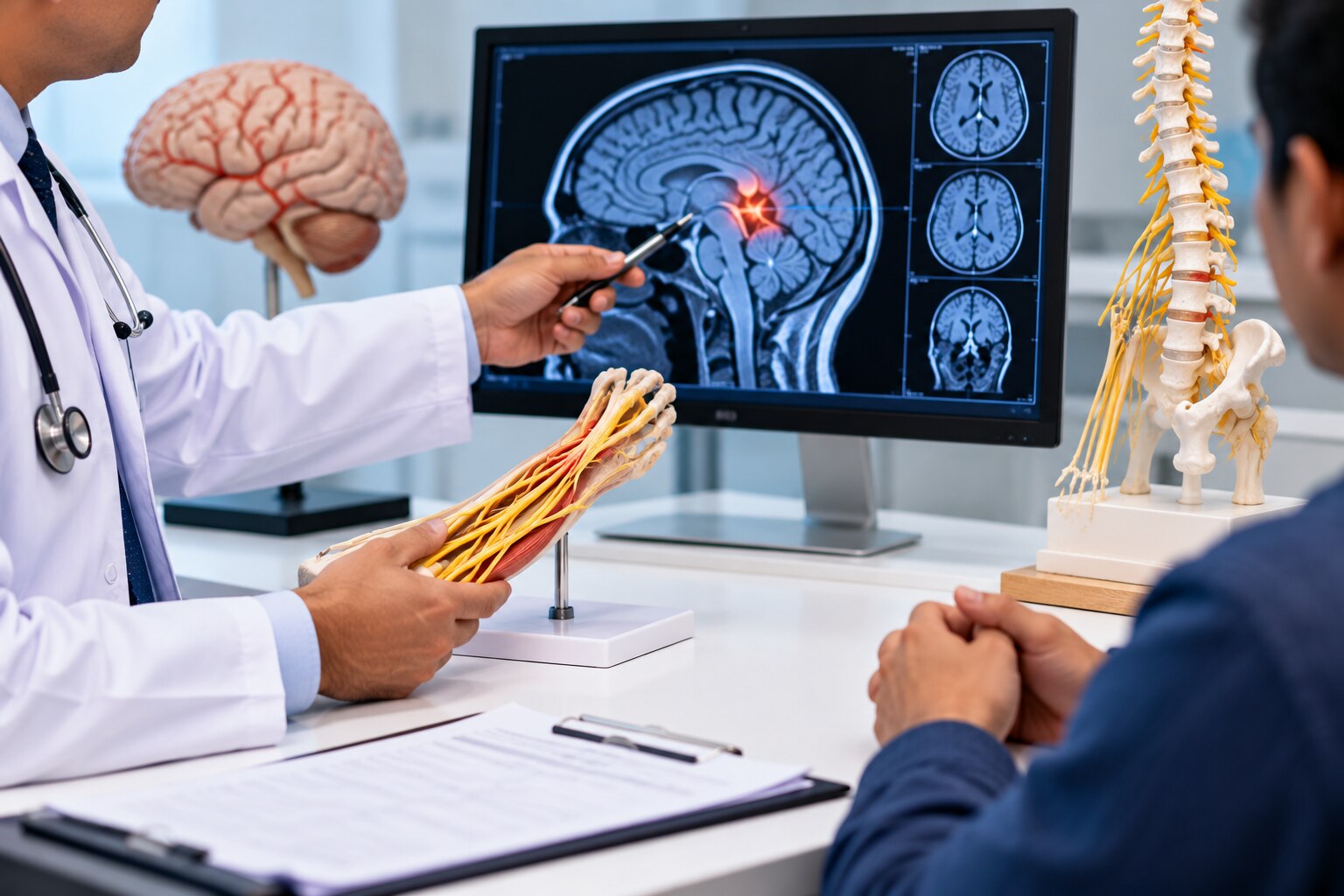
A numb, weak or painful limb does not identify the damaged structure: the problem may lie in the brain, spinal cord, nerve root, plexus, peripheral nerve, tendon or blood vessels. You will learn what to bring to the first appointment, which tests clarify the injury, when treatment is urgent and how specialists decide between observation, rehabilitation and reconstruction.
Key takeaways
- Seek urgent care for rapidly worsening weakness, severe pain or a cold, pale limb.
- Bring the injury mechanism, date, prior treatment, medicines and tetanus record.
- EMG and nerve-conduction studies help distinguish compression from axon loss.
- Ask whether observation, decompression, nerve repair or reconstruction fits your findings.
What happens at the first nerve injury appointment, and when is it urgent?
Record the injury date and mechanism before the first consultation: laceration, crush, traction, fracture, dislocation, injection, burn, electrical injury or surgery. This nerve injury treatment evaluation in Mumbai also tracks whether weakness, numbness or pain is worsening, previous treatment, tetanus status and relevant medical history.
- Bring emergency-room or operative records, imaging discs, medication lists and clear wound photographs. Include discharge papers, splints, injections and any changes in movement or sensation since the injury.
- Expect testing of named muscles, not just a general strength grade. The specialist will map sensation by nerve territory, compare reflexes and range of motion, look for muscle wasting or paralysis, and check Tinel’s sign.
- The examination also records skin colour and temperature, sweating or other autonomic changes, pulses and signs of vascular compromise. These findings help decide whether routine nerve injury treatment in Mumbai is appropriate or whether another injury needs priority.
Go to an emergency department rather than waiting for a routine appointment if you have an open wound with a suspected cut nerve, rapidly worsening weakness or numbness, a cold or pale limb, or tense swelling with severe pain.
Severe neck or back trauma, loss of bladder or bowel control, or new breathing, swallowing, speech or facial symptoms also require immediate assessment.
How does a specialist locate the injury instead of treating all numbness as one problem?
A specialist localises the lesion by matching exact weak muscles, reflex changes and sensory territories—not by accepting “my hand is numb” as a diagnosis. Side-to-side comparison and serial examinations reveal patterns that a single scan can miss.
- Brain lesion: weakness follows a body-side pattern and may include speech, vision, coordination or facial signs.
- Spinal-cord injury: weakness, altered reflexes and a defined sensory level can affect both legs or all four limbs.
- Nerve-root compression: pain and weakness follow a dermatome and myotome, often with a reduced reflex.
- Brachial or lumbosacral plexus injury: deficits cross individual nerve territories after traction or major trauma.
- Named peripheral-nerve damage: weakness and numbness fit one nerve, while a branching fascicle problem affects only selected muscles or skin areas.
- Neuromuscular-junction disorders cause fluctuating weakness without a matching sensory territory; diffuse polyneuropathy usually produces symmetrical distal loss.
The examination also checks whether the problem is a tendon rupture, fracture, dislocation, vascular injury, compartment syndrome, infection or complex regional pain syndrome. Severe pain, colour or temperature change, swelling, restricted movement and absent pulses can point away from isolated nerve damage.
Mechanism guides the search: a laceration raises concern for transection; traction suggests plexus injury; fracture or dislocation suggests structural damage. Crush, compression, injection, burn, electrical and surgical injuries each require targeted testing.
A nerve injury treatment evaluation in Mumbai may involve neurosurgery, neurology, orthopaedics, plastic surgery, peripheral-nerve surgery and rehabilitation. A peripheral nerve specialist in Mumbai, including a brain-surgery specialist, is not automatically the only appropriate referral.
Which tests show whether the nerve is intact, compressed or losing axons?
Nerve-conduction studies measure signal speed, amplitude and conduction block, helping show whether fibres conduct normally, slow at a compression site or have lost axons. Needle electromyography identifies denervation and later reinnervation, while helping localise root disease, plexus disease and entrapment.
Test timing matters. Immediately after injury, electrodiagnostic testing can underestimate axonal loss because denervation changes often become clearer after roughly two to three weeks. Serial studies, combined with repeat strength and sensory examinations, can track recovery; an early normal result does not prove that useful function will return.
| Test | What it contributes | Important limitation |
|---|---|---|
| Nerve-conduction study | Measures speed, amplitude and conduction block | Early testing can miss evolving axonal loss |
| Needle electromyography | Shows denervation, reinnervation, root, plexus and entrapment patterns | Findings become clearer after about two to three weeks |
| High-resolution ultrasound | Shows discontinuity, swelling, scar, entrapment or neuroma in accessible nerves | It cannot assess every deep or inaccessible nerve |
| MRI or MR neurography | Assesses nerves, roots, plexus, surrounding soft tissues and structural injury | It needs examination and electrodiagnostic correlation |
| X-ray or CT | Detects fractures, dislocations and foreign bodies | It does not measure nerve function |
A scan and an electrical test answer different questions. The examination must establish whether the findings fit the weakness, sensory territory and mechanism; treatment planning then weighs observation, decompression, repair, grafting and other nerve damage treatment options within the nerve injury surgery evaluation.
How do findings determine observation, nerve repair or reconstruction?
Findings determine whether observation is safe or reconstruction is time-sensitive. Neurapraxia is a temporary conduction block that often improves as the nerve recovers. Axonotmesis damages axons while preserving some surrounding structure, whereas neurotmesis severely disrupts or divides the nerve; these injuries carry different prognoses and treatment needs.
| Finding | Likely approach | Reason |
|---|---|---|
| Stable, incomplete deficit | Protection, splinting, pain treatment, physiotherapy or occupational therapy, and repeat examination | Function may return without reconstruction |
| Open laceration, suspected transection, progressive weakness, severe compression, enlarging mass, or failed recovery | Exploration or decompression, followed by repair or reconstruction when needed | Ongoing disruption or pressure can destroy recoverable function |
| Nerve ends meet without tension | Direct epineurial or group-fascicular repair | Reconnection is possible across a short gap |
| Larger gap or proximal injury | Autologous nerve graft, processed allograft, conduit, or nerve transfer | The original pathway cannot be joined directly or regeneration would take too long |
| Recovery unlikely after prolonged denervation | Tendon transfer | A functioning tendon can restore movement when nerve recovery is no longer realistic |
These nerve damage treatment options depend on the injury level, gap length, contamination, target-muscle viability and examination findings. Axons regenerate slowly, often near 1 mm per day, so delay can reduce fine motor recovery without making every late case inoperable.
Surgery does not instantly restore movement or sensation. A nerve injury treatment in Mumbai should include a dated reassessment plan, pain control and structured rehabilitation that retrains strength, coordination and useful daily movements.
What should a credible Mumbai consultation produce before you choose treatment?
A credible consultation leaves you with a documented baseline, a time-based recovery plan and a clear next decision—not merely “the nerve is damaged.” The clinician should state the suspected anatomical level, name weak muscles and affected sensory territories, document whether the nerve remains in continuity, explain whether axons are regenerating, and list tests still needed.
| Consultation output | What you should receive | Why it matters |
|---|---|---|
| Anatomical localisation | Brain, spinal cord, root, plexus or named peripheral nerve | Determines the appropriate specialist and treatment |
| Functional baseline | Muscle power, sensation, reflexes, wasting, pain and range of motion | Makes change measurable |
| Recovery plan | Expected window, therapy goals and repeat-test date | Prevents indefinite observation |
| Decision trigger | The finding that would change observation to surgery | Links follow-up to action |
Ask these questions before accepting a plan:
- What function is realistically recoverable, and which movement or sensory loss may remain permanent?
- How will burning or electric-shock pain be treated if motor recovery progresses separately?
- Which protection, splinting, physiotherapy or occupational-therapy goals come first?
- When will the next examination or electrodiagnostic test occur?
- What result—progressive weakness, absent reinnervation, persistent compression or another finding—would prompt surgery?
A nerve injury surgery evaluation in Mumbai may appropriately include Dr. Anshu Warade when a neurosurgical assessment is needed. A peripheral nerve specialist in Mumbai may instead coordinate with neurology, orthopaedics, plastic surgery, pain medicine or rehabilitation, depending on the lesion.
This coordinated approach is often more suitable than treating every complaint through brain surgery alone.
Related service
Neurological Examination 🧠 Neurological Examination by Dr. Anshu Warade A Neurological Examination is a detailed clinical assessment used to evaluate the functioning of the... View service → |
Frequently asked questions
What happens at the first nerve injury appointment in Mumbai?
The specialist records the injury date and mechanism, maps weakness and sensory loss, checks pain and circulation, reviews prior treatment and medicines, and asks about tetanus status and medical history.
When is a nerve injury urgent?
Seek urgent assessment for rapidly worsening weakness or numbness, severe escalating pain, a cold or pale limb, loss of movement after trauma, an open wound, or suspected compartment syndrome.
How does a specialist locate a nerve injury?
The examination maps the affected muscles, skin territories and reflexes against the injury mechanism. This helps distinguish a single peripheral nerve lesion from a nerve-root, plexus, spinal cord or brain problem.
Which tests show whether a nerve is intact, compressed or losing axons?
Nerve-conduction studies assess signal transmission, while electromyography detects denervation and muscle recovery. Ultrasound or MRI can show nerve discontinuity, compression, swelling, scar tissue or nearby structural damage.
How do findings determine nerve injury treatment options?
A functioning nerve with stable or improving symptoms may be observed. Persistent compression can require decompression, while a cut nerve may need direct repair, grafting, nerve transfer or another reconstruction.
Keywords